System Architecture
Hardware software co design with interface design, performance optimization, and system integration.
Why Embedded Hardware Engineering Is the Foundation
Optimized hardware software integration
Scalable and modular design
Reduced development time and costs
Future proof architecture
What Is System Architecture?
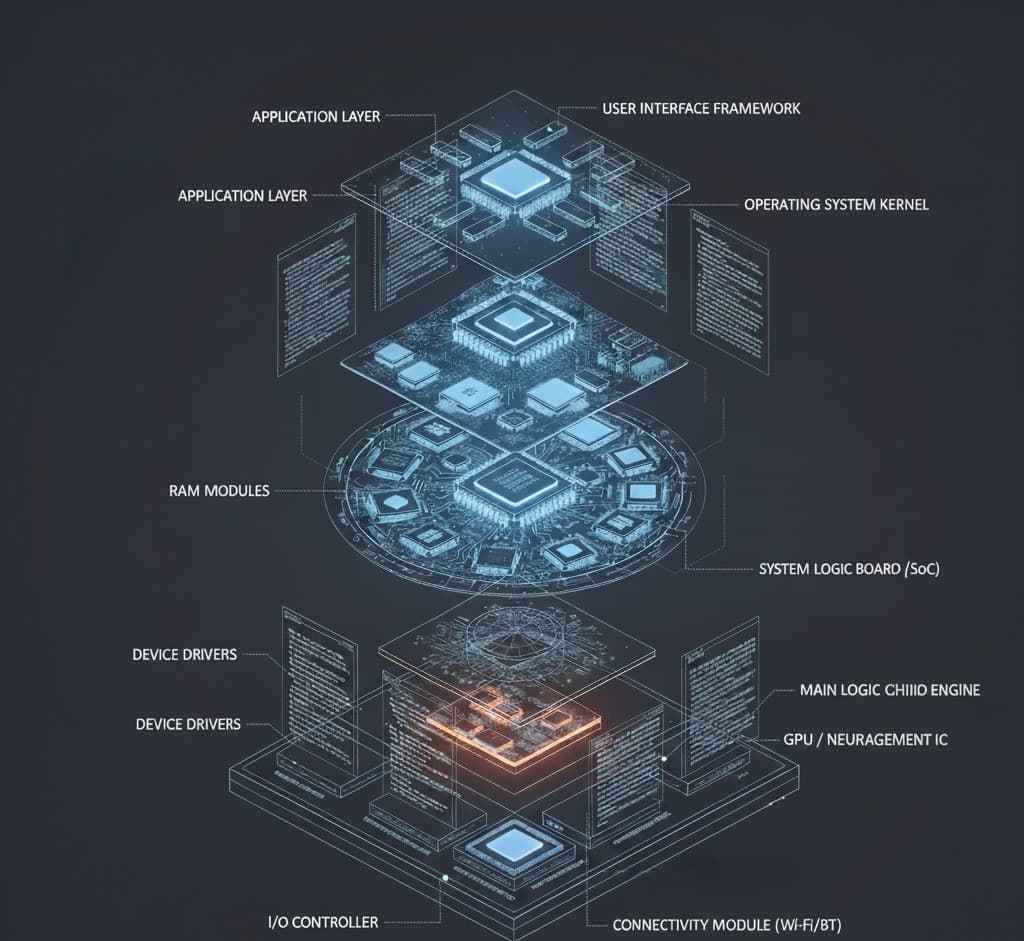
EmbedCrest Technology's embedded hardware engineering and System Architecture service provides comprehensive hardware software co-design for complex embedded products. As one of the top embedded systems companies in India, we define the system level blueprint that governs processor selection, memory hierarchy, bus topology, peripheral allocation, power delivery architecture, and software partitioning. Our architects evaluate SoC and MPSoC options from vendors including NXP, STMicroelectronics, Texas Instruments, Renesas, and Xilinx, performing trade studies that balance performance, power consumption, cost, and supply chain availability. We create detailed interface control documents, timing diagrams, and state machine specifications that bridge the gap between hardware and firmware teams. Using model based design with MATLAB Simulink and virtual prototyping with Renode and QEMU, we validate architectural decisions before physical prototypes exist. As a trusted embedded systems solutions provider, EmbedCrest's system architecture service reduces design iterations, shortens time to market, and ensures your product meets its functional and non functional requirements from the first silicon bring up.
Real World Applications of System Architecture
Multi-Core SoC Platform Design for Robotics
Architect a heterogeneous compute platform combining Cortex-A cores for Linux based navigation with Cortex-R cores for real time motor control and a dedicated ML accelerator, defining inter-processor communication channels and shared memory regions.
Low Power Wearable Device Architecture
Design the complete system architecture for a battery powered health wearable including processor selection, sensor integration, power management IC specification, and BLE communication stack, optimizing for a 72-hour continuous use battery target.
Modular Industrial Gateway Platform
Create a scalable gateway architecture with hot-swappable communication modules for Ethernet, cellular, Wi-Fi, and LoRaWAN, supporting field upgradability through standardized hardware interfaces and a containerized software stack.
Our Embedded Systems Architecture Design Process
System Analysis
We begin with a deep dive into functional and non functional requirements to understand your product's purpose and constraints.
Architecture Design
Our team creates comprehensive system blueprints that serve as the fundamental structure for both hardware and software components.
Interface Design
We define robust hardware software interfaces that facilitate seamless communication between different system modules.
Optimization
The final stage focuses on fine tuning the architecture to meet real time operational requirements under strict resource constraints.
Embedded Systems Architecture Design Tools and Standards
Technologies
Tools
Standards
Frequently Asked Questions About System Architecture
What does hardware software co-design involve in embedded system architecture?
Hardware software co-design is the practice of making hardware and software architectural decisions simultaneously rather than sequentially. We partition functionality between hardware accelerators and software routines, define memory maps and register interfaces, and ensure the processor has sufficient compute headroom. This approach prevents costly redesigns that occur when hardware and software teams work in isolation.
How do you select the right processor or SoC for a new product?
We evaluate candidates against your performance benchmarks, power budget, peripheral requirements, operating temperature range, long term availability, cost at volume, and ecosystem maturity. We create weighted decision matrices and often prototype critical algorithms on evaluation boards before committing to a specific SoC to validate real world performance.
What is virtual prototyping and how does it reduce development risk?
Virtual prototyping uses tools like Renode or QEMU to create a software model of your hardware platform before physical boards are available. Firmware engineers can begin development, test peripheral drivers, and validate system behavior months before first silicon. This overlaps hardware and software schedules and catches interface issues early.
How do you handle thermal and power management in system architecture?
We define power domains, voltage rails, and sleep state transitions at the architecture level. We specify PMIC configurations, clock gating strategies, and dynamic voltage frequency scaling policies. Thermal analysis includes estimating power dissipation per component, defining thermal interface material requirements, and specifying fan or heatsink solutions when passive cooling is insufficient.
What documentation do you deliver as part of system architecture services?
We deliver system block diagrams, interface control documents, memory map specifications, timing constraint analyses, power budget spreadsheets, SoC selection trade studies, and software architecture documents. For safety critical projects, we also provide FMEA reports and hazard analyses. All documentation follows your preferred standards or industry norms like IEEE 1471.
Projects Using This Service
See how we have applied system architecture in real engagements.