Smart Agriculture IoT Sensor Network for Precision Farming
Project Overview
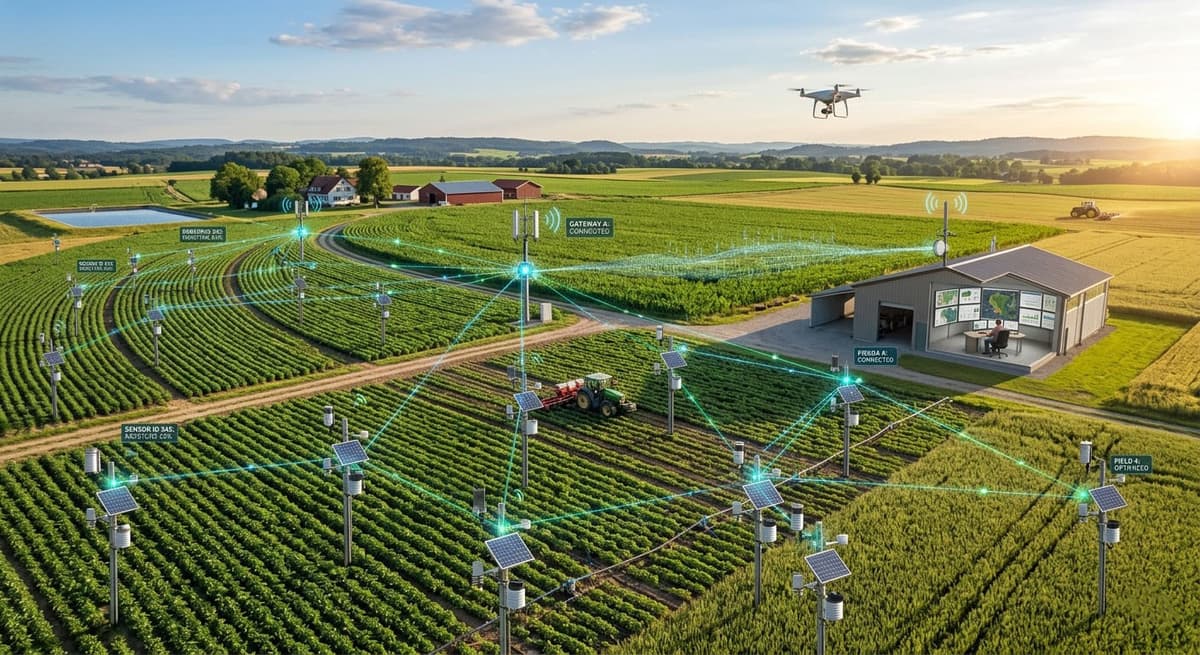
EmbedCrest, a leading industrial IoT solutions provider based in India, partnered with TerraNova AgriTech to engineer a comprehensive precision farming IoT platform spanning over 12,000 acres of diverse agricultural land. The project involved designing 850 custom solar powered sensor nodes using STM32WL microcontrollers, each integrating capacitive soil moisture probes, NPK nutrient sensors, and environmental monitors. A LoRaWAN mesh network connected these nodes to 24 hardened gateways featuring on device TinyML solutions built with TensorFlow Lite Micro for real time anomaly detection systems and automated irrigation control. The gateways relayed aggregated telemetry to AWS IoT Core over LTE-M backhaul, feeding a centralized dashboard for fleet management and predictive analytics solutions. By processing critical decisions at the edge through our embedded software solutions, the system reduced cloud round trip latency to near zero for time sensitive irrigation triggers. Delivered by our embedded hardware engineering team from our offices in Mumbai and Pune, the project resulted in a 38 percent reduction in water consumption and a 22 percent increase in crop yield across the first harvest cycle.
Problem Statement
TerraNova AgriTech operated over 12,000 acres of farmland across multiple regions and relied on manual soil sampling and weather observation for irrigation and fertilization decisions. This labor intensive process led to significant water waste, inconsistent crop yields, and an inability to respond to microclimatic variations in real time. They needed an industrial IoT solutions provider who could deliver a complete embedded systems solution from sensor hardware to cloud analytics.
Engineering Approach
EmbedCrest designed and deployed a distributed IoT sensor network consisting of 850 solar powered sensor nodes, each equipped with capacitive soil moisture, temperature, humidity, and NPK nutrient sensors. The nodes communicated over a LoRaWAN mesh network to 24 ruggedized gateway units running custom firmware on STM32WL microcontrollers, which aggregated data and forwarded it to AWS IoT Core via LTE-M backhaul. An Edge AI pipeline built with TensorFlow Lite Micro on each gateway performed local anomaly detection and irrigation scheduling, reducing cloud dependency and enabling sub-second response to sudden soil moisture drops. Our embedded developers implemented a custom task scheduler on FreeRTOS with three priority levels: critical sensor sampling at the highest priority, LoRaWAN transmission at medium priority, and diagnostic self-test routines at idle priority. Power optimized firmware development was handled through a state machine that transitioned the STM32WL between Run, Low Power Run, Stop Mode 1, and Stop Mode 2 based on the current task phase, achieving an average current draw of 12 microamps during sleep intervals. The solar energy harvesting subsystem used a maximum power point tracking circuit paired with a 10 farad supercapacitor bank, providing 72 hours of operation without sunlight as a buffer against monsoon conditions. The entire solution was engineered and delivered from our development center in India.
Measurable Outcomes
38%
Water usage reduction
22%
Crop yield improvement
18 months
Sensor node battery life
99.7%
Data transmission reliability
Technologies Used
“EmbedCrest transformed how we manage our farms. The sensor network gives us field level visibility we never had before, and the edge intelligence means our irrigation systems react faster than any human operator could. We saw ROI within the first growing season.”
Rajesh Kulkarni
CTO, TerraNova AgriTech
Note: Client details have been anonymized to protect confidentiality. Project outcomes and technical specifications are representative of actual engagements.
Frequently Asked Questions
How do the sensor nodes survive harsh outdoor conditions?
Each sensor node is housed in an IP67 rated enclosure with conformal coated PCBs, designed to withstand temperatures from minus 10 to 60 degrees Celsius, heavy rain, and UV exposure. Solar energy harvesting with supercapacitor backup ensures continuous operation for up to 18 months without maintenance.
What wireless protocol was used and why?
LoRaWAN was selected for its long range capability of up to 10 kilometers in open fields, ultra low power consumption, and robust performance in rural environments with minimal infrastructure. LTE-M was used as a backhaul from gateways to the cloud for reliable cellular connectivity.
Can the system scale to additional farmland?
Yes, the architecture is fully modular. New sensor nodes automatically join the LoRaWAN network via OTAA provisioning, and additional gateways can be deployed without reconfiguring existing infrastructure. The AWS IoT backend auto scales with device count.
How was power consumption optimized for 18 month battery life?
Our MCU firmware development team implements a multi-tier sleep strategy on the STM32WL. Between sampling intervals, the MCU enters Stop Mode 2 drawing under 2 microamps. The LoRaWAN radio uses Class A operation with adaptive data rate to minimize transmit time. A custom power management IC coordinates solar panel charging with supercapacitor storage, and a hardware watchdog ensures the system recovers from any unexpected wake state. Sensor excitation circuits are only powered during active measurement windows, typically lasting 120 milliseconds per cycle.
What calibration process was used for soil sensors across different terrain types?
Each sensor node underwent a two-phase calibration process. Factory calibration established baseline curves using standardized soil samples across five soil types including clay, loam, sandy, silt, and peat. Field calibration was performed during installation using local soil core samples analyzed in a laboratory, generating per-node correction coefficients stored in on-chip flash. The firmware applies temperature compensation algorithms to account for dielectric constant variations caused by soil temperature changes throughout the day.