Smart Home Hub with Matter Protocol and Thread Networking
Project Overview
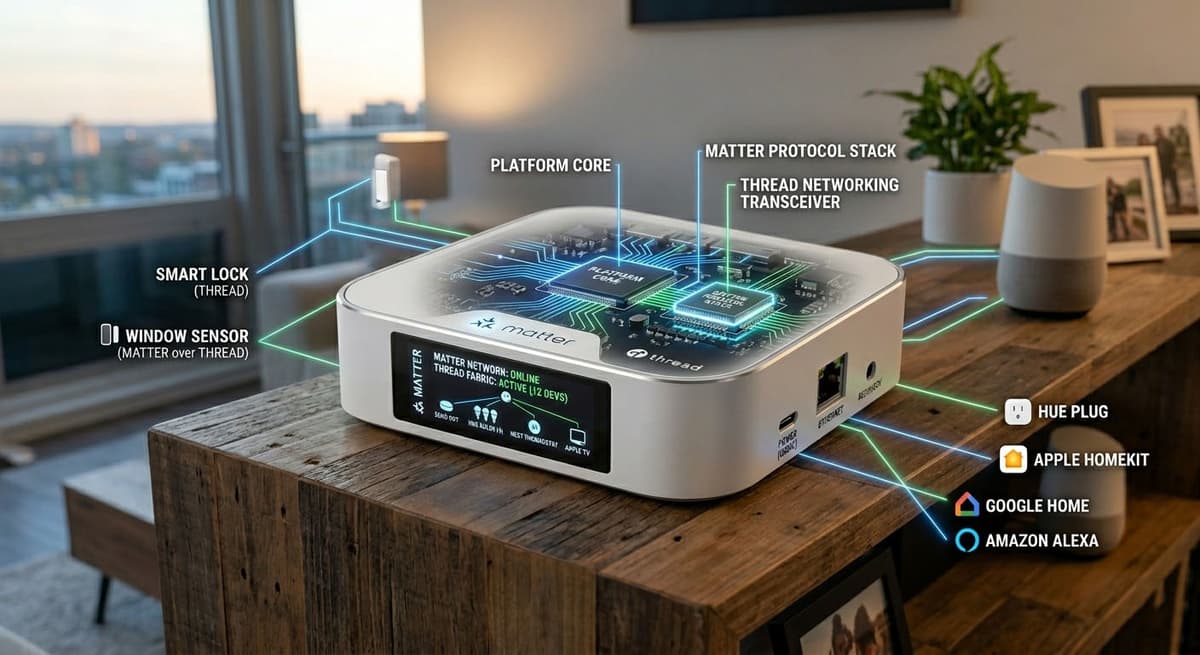
EmbedCrest, a firmware development company and IoT software engineering services provider based in India, partnered with Lumina Connected Living to develop a Matter certified smart home hub capable of unifying devices across multiple ecosystems. Our embedded developers built the hardware platform combining a Silicon Labs EFR32MG24 multiprotocol SoC for Thread and Zigbee 3.0 radio management with an NXP i.MX8M Mini application processor running a Buildroot based embedded Linux distribution. The EFR32MG24 executed dynamic multiprotocol scheduling to handle Thread 1.3 and Zigbee 3.0 traffic concurrently, while serving as a Thread border router for IPv6 connectivity to the home network. The Matter 1.2 controller stack on the i.MX8M managed device commissioning, operational discovery, and group control, supported by a local automation engine that executed rules with sub-30ms latency. Security was implemented at every layer using EFR32 Secure Vault for hardware backed key storage, mutual TLS for device communication, and encrypted persistent storage. Our software testing and automation team validated interoperability against over 120 Matter certified devices from 30 manufacturers, culminating in successful Matter 1.2 certification. The custom software development was delivered from our engineering center in India, serving clients across Mumbai, Pune, and Bangalore.
Problem Statement
Lumina Connected Living was launching a next generation smart home hub that needed to unify devices from multiple ecosystems under the Matter standard. The hub required Thread border router functionality, backward compatibility with Zigbee 3.0 devices, ultra low latency local automation under 50ms, and compliance with Matter 1.2 certification requirements while maintaining a consumer friendly setup experience. They needed a firmware development company with deep IoT software engineering services expertise.
Engineering Approach
EmbedCrest developed the hub firmware on a Silicon Labs EFR32MG24 multiprotocol SoC paired with an NXP i.MX8M Mini application processor running embedded Linux. The EFR32 handled Thread and Zigbee 3.0 radio duties simultaneously using dynamic multiprotocol scheduling, while the i.MX8M ran the Matter controller stack, local automation engine, and a lightweight web interface for device commissioning. A custom Thread border router implementation enabled seamless IPv6 routing between Thread devices and the home Wi-Fi network. The security architecture incorporated hardware backed certificate storage using the EFR32 Secure Vault, mutual TLS for all device communications, and encrypted local storage for automation rules. Our software testing and automation team conducted comprehensive interoperability testing covering over 120 Matter certified devices from 30 manufacturers, ensuring a seamless consumer experience out of the box.
Measurable Outcomes
<30ms
Local automation latency
Achieved (v1.2)
Matter certification
30+ brands
Supported device ecosystems
<45 seconds
Average setup time per device
Technologies Used
“EmbedCrest navigated the complexity of multi-protocol smart home development with remarkable expertise. Our hub pairs with devices from dozens of brands in under a minute, and the local automation speed makes our product feel truly responsive. They delivered a product that stands out in a crowded market.”
Sarah Chen
Director of Product, Lumina Connected Living
Note: Client details have been anonymized to protect confidentiality. Project outcomes and technical specifications are representative of actual engagements.
Frequently Asked Questions
How does the hub handle both Thread and Zigbee simultaneously?
The Silicon Labs EFR32MG24 supports dynamic multiprotocol operation, time slicing between Thread and Zigbee 3.0 on the same 2.4GHz radio. A custom scheduler prioritizes time critical Thread routing packets while ensuring Zigbee devices maintain reliable connectivity with minimal latency impact.
What happens if the internet connection goes down?
All automation rules execute locally on the hub with no cloud dependency. The Matter controller, Thread border router, and Zigbee coordinator continue operating normally during internet outages. Only remote access and cloud based voice assistant integrations are temporarily unavailable.
How is firmware updated on the hub?
The hub supports A/B partition OTA updates with automatic rollback. Updates are downloaded over Wi-Fi, cryptographically verified using hardware backed keys in the Secure Vault, and applied during a controlled reboot. The entire process takes under 90 seconds with zero downtime for connected devices.