BLE (Bluetooth Low Energy) is the better choice for battery powered devices that exchange small amounts of data with a nearby phone or gateway, while WiFi is the better choice for mains powered devices that need direct internet access or throughput above a few hundred kbps. The decision usually comes down to three questions: what powers the device, what it connects to, and how much data it moves.
What is the core difference between BLE and WiFi?
BLE was designed from the start for short bursts of data and long sleep periods. A BLE peripheral advertises, accepts a connection from a central such as a smartphone or gateway, and exposes data through GATT (Generic Attribute Profile) services. Average current can stay in the microamp range for sensors that report every few seconds. BLE does not carry IP by default, so data reaches the cloud through a phone app or a gateway.
WiFi (IEEE 802.11) gives a device a native IP address on the local network and therefore a direct path to cloud services over MQTT (Message Queuing Telemetry Transport) or HTTPS (Hypertext Transfer Protocol Secure). That convenience costs energy: transmit peaks on common WiFi microcontroller modules are typically 150 to 350 mA, and associating with an access point takes noticeable time. WiFi 6 (802.11ax) adds TWT (Target Wake Time), which lets a station agree sleep schedules with the access point and improves battery life where the infrastructure supports it.
How do BLE and WiFi compare for Internet of Things (IoT) products?
Typical values for microcontroller class devices; measure your own hardware for final figures.
| Criterion | BLE (Bluetooth 5.x) | WiFi (802.11 b/g/n/ax) |
|---|---|---|
| Power source fit | Coin cell or small battery for months to years | Mains, Power over Ethernet (PoE) adapter or large rechargeable battery |
| Typical indoor range | Typically 10 to 30 m; longer with Coded PHY (physical layer) | Typically 30 to 50 m to an access point |
| Practical throughput | Typically up to about 1 Mbps application data on 2M PHY | Typically several Mbps on microcontroller unit (MCU) modules, far more on Linux class devices |
| Path to cloud | Through a phone app or BLE gateway | Direct IP to broker or API |
| Topology | Point to point, broadcast, Bluetooth Mesh | Star around access points; mesh systems for coverage |
| Provisioning | Pair or connect from an app, no network credentials needed | Must receive the network name (SSID) and password, often via BLE or a temporary access point (SoftAP) |
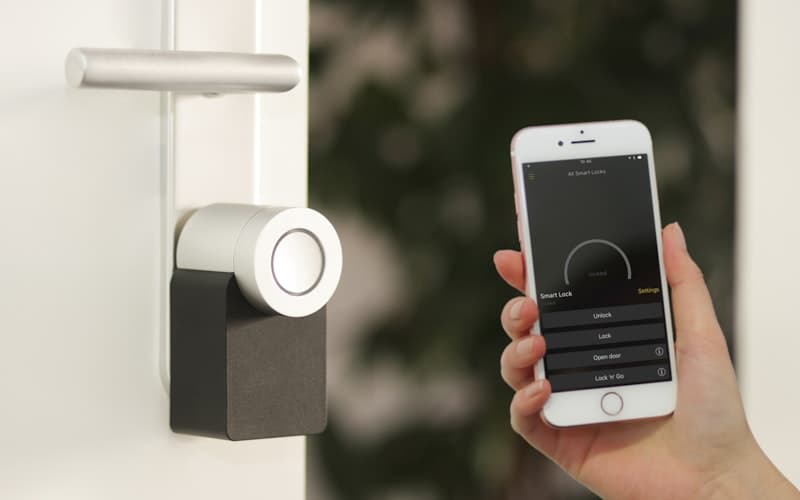
| Typical use cases | Wearables, medical sensors, beacons, tools, locks | Cameras, appliances, gateways, displays, energy monitors |
| Ecosystem notes | Every smartphone supports it | Matter over WiFi for smart home; enterprise WPA2/WPA3 (WiFi Protected Access) Enterprise adds work |
How do you estimate battery life for each radio?
Battery life is battery capacity divided by average current. Average current is the sum, for each activity, of its current multiplied by its duration, divided by the reporting interval, plus sleep current. For illustration with hypothetical numbers: a BLE sensor that draws 6 mA for 3 ms per advertising event every 1 second averages about 18 µA from radio activity; a WiFi sensor that draws 120 mA average for 1.5 seconds to wake, associate and publish once every 10 minutes averages about 300 µA. On a 1,000 mAh battery and ignoring sleep current and self discharge, that is roughly 6 years versus 4.5 months. Replace these values with measurements from your module and firmware.
How do you choose between BLE and WiFi?
Work through these steps in order:
- Step 1: Fix the power budget: battery type and capacity in mAh, required life in months, or confirmation that mains power is available.
- Step 2: Define the data: bytes per report, reports per hour, peak bursts such as logs or images, and acceptable delay.
- Step 3: Decide where data must go. If a phone app is always present, BLE is natural; if data must reach the cloud unattended, WiFi or a BLE gateway is needed.
- Step 4: Check the installation: is there reliable WiFi at the mounting point, and will the customer IT (information technology) team allow IoT devices on it?
- Step 5: Plan provisioning and security: pairing method for BLE, credential onboarding and certificate storage for WiFi.
- Step 6: Prototype on a development kit and measure current with a power analyzer before freezing the PCB (Printed Circuit Board) design.
As a summary rule: battery powered, small data and a phone or gateway nearby points to BLE; mains powered, direct cloud connection or more than a few hundred kbps points to WiFi; a consumer product that needs easy setup and cloud access usually points to both. If the answers conflict, for example a battery device that must reach the cloud unattended with no gateway, revisit the requirement or consider a cellular LPWAN (Low Power Wide Area Network) radio instead.
Combo chips that integrate BLE and WiFi, such as several ESP32 variants or a BLE SoC (System on Chip) paired with a WiFi companion chip, let a product use BLE for onboarding and local control and WiFi for cloud data. This is now the default architecture for many smart home and appliance products, and it removes the need for a separate setup access point.
How do security requirements differ between BLE and WiFi devices?
For BLE, security starts with the pairing method. LE (Low Energy) Secure Connections with numeric comparison or passkey entry protects against eavesdropping and man in the middle attacks; Just Works pairing does not authenticate the peer and should be avoided for anything that controls hardware. Many products also add application layer encryption so that a compromised phone app cannot impersonate the device. For WiFi, the device must store network credentials and a device certificate or token for the cloud, use WPA2 or WPA3 on the network side and TLS (Transport Layer Security) to the broker, and protect those secrets in flash using encryption or a secure element.
How do interference and coexistence affect the choice?
Both radios commonly share the 2.4 GHz band with each other, with microwave ovens and with dense neighbouring networks. BLE hops across 37 data channels and uses adaptive frequency hopping to avoid busy ones, which makes it resilient in crowded spaces. WiFi on 2.4 GHz has only three non overlapping 20 MHz channels, so apartment blocks and offices can be congested; dual band devices that also support 5 GHz avoid much of that. In combo designs that use one antenna for both radios, the coexistence scheme in the chip firmware decides which radio transmits, so test throughput and latency with both active, not separately.
When does this comparison not apply?
If devices are spread over kilometres or have no local infrastructure, neither radio fits; look at LoRaWAN (Long Range Wide Area Network), NB IoT (Narrowband IoT) or LTE M (Long Term Evolution for Machines) instead. If the product joins a smart home ecosystem, Thread and Matter requirements may decide the radio for you. Industrial sites with heavy metal structures, strict IT policies or radio restrictions may rule out WiFi entirely. Regulatory approvals also differ by market, so plan radio certification for every country where the product will be sold.
Sources and standards
Specifications referenced in this article:
- Bluetooth Core Specification 5.x (Bluetooth Special Interest Group, SIG)
- Bluetooth Mesh Protocol Specification (Bluetooth SIG)
- IEEE 802.11 (WiFi), including 802.11ax Target Wake Time
- Matter specification (Connectivity Standards Alliance)