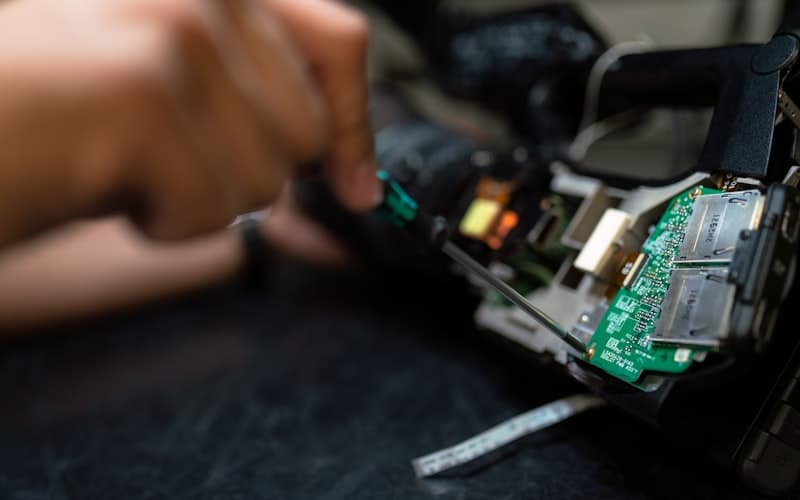
A Battery Management System (Battery BMS) is embedded electronics and firmware inside a battery pack that measures cell voltages, current and temperatures, estimates state of charge and state of health, balances cells and opens contactors to keep the pack safe. A Building Management System (Building BMS), also called a Building Automation System, monitors and controls building services such as HVAC (Heating, Ventilation and Air Conditioning), lighting, pumps and energy meters. They share an acronym, but they solve different problems with different hardware, protocols and standards.
What does a Battery Management System do?
A Battery BMS sits inside an EV (Electric Vehicle) pack, an energy storage system, an e bike or an industrial battery. Analog front end chips measure each series cell voltage, typically with millivolt accuracy, along with pack current and several temperature points. Firmware on a microcontroller estimates SOC (State of Charge) and SOH (State of Health), applies protection limits for over voltage, under voltage, over current and temperature, performs passive or active cell balancing and controls contactors or MOSFET (metal oxide semiconductor field effect transistor) switches. It communicates with the charger, inverter or vehicle controller, commonly over CAN (Controller Area Network) or Modbus. Response to a fault is required within milliseconds.
What does a Building Management System do?
A Building BMS is a network of DDC (Direct Digital Control) controllers, field devices and a supervisory server. Controllers run control loops for air handling units, chillers, fan coil units and lighting; the supervisory layer provides schedules, alarms, trends and energy reports. Devices communicate over BACnet, Modbus, KNX or vendor protocols, and integration with fire, access control and metering systems is common. Typical control actions happen over seconds to minutes, and the main goals are occupant comfort, energy efficiency and maintenance visibility.
How do a Battery BMS and a Building BMS compare?
The table compares both systems on the criteria that matter when scoping an RFQ (request for quotation).
| Criterion | Battery Management System (Battery BMS) | Building Management System (Building BMS) |
|---|---|---|
| Purpose | Protect and monitor a battery pack | Control and monitor building services |
| Where it lives | Inside the pack or battery rack | Plant rooms, panels, server and dashboard |
| Key measurements | Cell voltages, pack current, cell temperatures | Temperatures, humidity, CO2, flows, energy, equipment status |
| Response time | Milliseconds for protection functions | Seconds to minutes for control loops |
| Typical protocols | CAN, CAN FD (CAN with Flexible Data rate), SAE J1939, Modbus, isoSPI between modules | BACnet, Modbus, KNX, LonWorks, MQTT (Message Queuing Telemetry Transport) to cloud |
| Core algorithms | SOC and SOH estimation, balancing, fault detection | PID (proportional integral derivative) control, scheduling, optimization, fault detection and diagnostics |
| Relevant standards | IEC 62619, UL 1973, ISO 26262 for vehicles, Automotive Industry Standard (AIS) 156 (L category) and AIS 038 Rev 2 (M and N category) in India | ASHRAE 135 (BACnet), ISO 16484, EN 15232 or ISO 52120 |
| Engineering skills | Analog front end design, embedded firmware, functional safety | Controls engineering, HVAC knowledge, systems integration |
Where do a Battery BMS and a Building BMS meet?
The two systems meet in buildings with on site energy storage, solar generation or EV charging. A battery energy storage system has its own Battery BMS for safety, and an energy management controller or the Building BMS reads its SOC, available power and alarms, usually over Modbus TCP or through a gateway that translates CAN data into BACnet objects. The Building BMS can then schedule charging and discharging against tariffs or peak demand. The important design rule is that the Building BMS requests power and reads status, while the Battery BMS keeps final authority over safety limits.
What engineering work does each system involve?
Battery BMS projects are product engineering projects. The work covers schematic and printed circuit board (PCB) design around the cell monitoring chips with isolation between high voltage and low voltage domains, firmware for measurement, protection, balancing and contactor sequencing, SOC and SOH algorithms tuned with cell test data, CAN communication matrices, bootloaders for field updates, and validation on cell simulators and HIL (Hardware in the Loop) rigs before tests on real packs. For vehicles and large storage systems, a functional safety process with hazard analysis and safety requirements runs alongside the design from the start.
Building BMS projects are mostly integration and controls projects. The work covers a points list for every sensor and actuator, control sequences for each piece of equipment, controller programming, graphics, alarm and trend configuration, and integration of third party equipment such as chillers, variable refrigerant flow systems and meters through BACnet or Modbus gateways. Embedded engineering appears where a device lacks a suitable interface, for example a custom gateway or protocol converter that exposes legacy HVAC equipment as BACnet objects, or an Internet of Things (IoT) layer that streams building data to a cloud analytics platform.
Because the skill sets differ, a supplier strong in one is not automatically suited to the other. Ask for relevant project evidence for the specific BMS you need. Where a project touches both, for example a commercial building with rooftop solar and a lithium storage system, assign one owner for the interface between them and test it explicitly: loss of communication, conflicting commands and alarm propagation should all have defined, verified behaviour before handover.
How do you specify which BMS your project needs?
Use these steps when writing an RFQ or scope:
- Step 1: State the full term, Battery Management System or Building Management System, in every document title and requirement.
- Step 2: For a Battery BMS, specify cell chemistry, series and parallel configuration, voltage and current range, temperature range such as minus 20 °C to 60 °C, communication interfaces and target safety standards.
- Step 3: For a Building BMS, list equipment to be controlled, point count, existing controller brands and protocols, and integration targets such as metering or fire systems.
- Step 4: If both are involved, define the interface: which side owns which signals, update rates, protocol and behaviour on communication loss.
- Step 5: Agree test methods: hardware in the loop and cell simulators for a Battery BMS, point to point checkout and sequence testing for a Building BMS.
When does this comparison not apply?
Some literature uses BMS for other systems, such as a burner management system in boilers or a broader building energy management system (BEMS). If a document uses BMS without context, confirm the meaning before scoping. Also note that certification under the standards above is performed by accredited test laboratories on the final product; a design partner supports the client's compliance process but does not certify the product.
Sources and standards
Standards referenced in this article:
- IEC 62619 (safety of secondary lithium cells and batteries for industrial applications)
- UL 1973 (batteries for stationary and motive auxiliary power)
- ISO 26262 (road vehicle functional safety)
- AIS 156 (L category) and AIS 038 Rev 2 (M and N category) in India (EV traction battery safety)
- ASHRAE 135 and ISO 16484 Part 5 (BACnet)
- ISO 16484 series (building automation and control systems)
- ISO 52120 (contribution of building automation to energy performance, successor to EN 15232)