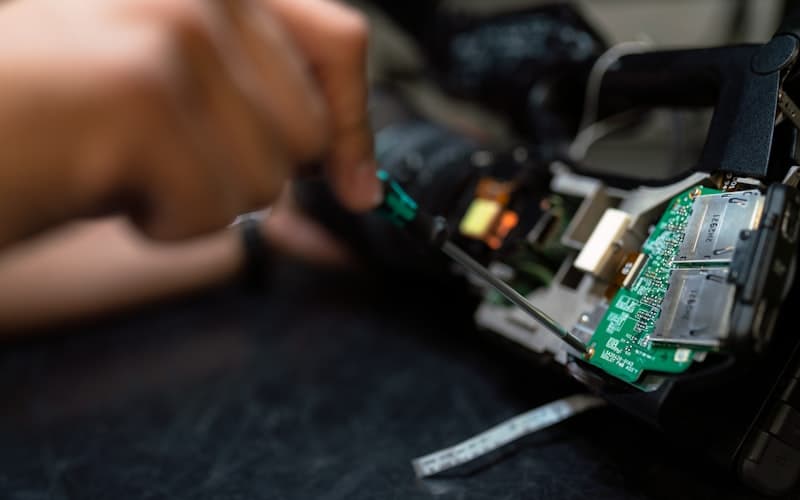
Hardware-in-the-Loop (HIL) testing is a validation methodology where a real embedded controller (ECU, PLC, or custom board) is connected to a real-time simulation of the physical system (plant model) it is designed to control. The HIL simulator generates sensor signals that the controller expects (voltage, current, PWM, CAN messages), receives the controller's actuator commands, and feeds them back into the plant model to close the control loop in real time. HIL testing sits at the integration and system validation levels of the V-model development process, between software-in-the-loop (SIL) testing and full physical prototype testing. It enables engineers to test thousands of operating scenarios, including dangerous fault conditions like brake failure or motor overtemperature, without risking physical hardware or human safety. Major HIL platforms include dSPACE SCALEXIO, National Instruments (now NI) VeriStand with PXI hardware, Speedgoat, and OPAL-RT, with real-time simulation rates from 1 kHz to 1 MHz depending on model complexity.
Where Does HIL Fit in the Development V-Model?
The V-model defines a structured development lifecycle where each design phase has a corresponding test phase. Model-in-the-Loop (MIL) testing validates control algorithms in a pure simulation environment like MATLAB/Simulink. Software-in-the-Loop (SIL) tests the generated or hand-written C code on a host PC. Processor-in-the-Loop (PIL) runs the code on the target processor but with simulated I/O. HIL testing runs the production firmware on the production hardware with simulated I/O signals, making it the closest approximation to real-world operation without a physical prototype. HIL catches integration issues that SIL and PIL miss: timing-dependent bugs, interrupt priority conflicts, peripheral driver errors, analog signal conditioning issues, and communication protocol edge cases.
What Hardware Components Make Up a HIL System?
A typical HIL test bench consists of:
- Real-time processor: FPGA-based (Xilinx Zynq, Intel Cyclone) or PowerPC/x86 real-time targets running a deterministic RTOS, executing plant models at 10-100 kHz update rates.
- I/O interfaces: Analog output channels (DAC) generating 0-5V or 4-20mA sensor signals, analog input channels (ADC) reading actuator commands, digital I/O for switches and PWM signals.
- Communication interfaces: CAN, CAN-FD, LIN, FlexRay, Ethernet/EtherCAT for automotive; PROFINET, EtherCAT, Modbus for industrial. Protocol-specific I/O boards handle physical layer timing.
- Fault injection hardware: Relay matrices and electronic load switches that can simulate open circuits, short circuits, and signal degradation to test the ECU's fault handling.
- Test automation software: dSPACE AutomationDesk, NI TestStand, or custom Python/MATLAB scripts that execute test sequences and log results automatically.
How Do You Create a Plant Model for HIL Simulation?
Plant models represent the physical system being controlled, an electric motor, hydraulic actuator, vehicle dynamics, or industrial process. Models are typically developed in MATLAB/Simulink or Modelica (via tools like Dymola or OpenModelica) and then compiled to run on the real-time target. The model's fidelity must match the controller's bandwidth: a motor current controller operating at 20 kHz requires a model with sub-microsecond electromagnetic dynamics, while a temperature controller operating at 1 Hz can use a simplified thermal model. FPGA-based HIL simulators (like dSPACE SCALEXIO with DS6601 FPGA boards) achieve 1 MHz model update rates for power electronics simulation, while CPU-based targets typically handle 10-100 kHz. The key challenge is ensuring the model is detailed enough to expose real controller issues while simple enough to execute within the real-time deadline.
What Are the Limitations of HIL Testing?
HIL testing cannot fully replace physical testing. The plant model is always an approximation, it may not capture nonlinearities, manufacturing variations, temperature effects, or electromagnetic interference present in the real system. Analog I/O resolution and bandwidth of the HIL simulator limit signal fidelity: a 16-bit DAC provides 76 uV resolution on a 0-5V range, which may not reproduce noise characteristics that affect sensitive analog front-ends. EMC (electromagnetic compatibility) testing, environmental stress testing, and mechanical vibration testing require physical prototypes. HIL is most effective when combined with other validation methods in a comprehensive test strategy, catching 70-90% of integration bugs before the first physical prototype is built.
Key takeaway: HIL testing validates embedded controllers by connecting real hardware to real-time plant simulations, catching 70-90% of integration bugs before physical prototyping. HIL sits between SIL (pure software simulation) and physical testing in the V-model, enabling safe testing of dangerous scenarios like brake failure or motor overtemperature without risking equipment or safety.
How Did We Build a Cost-Effective HIL System for a Startup?
At EmbedCrest, we helped an electric motor controller startup build a HIL test bench at a fraction of the cost of commercial dSPACE or NI systems. The device under test was a custom BLDC motor controller (STM32G4 with 20 kHz PWM switching) that needed validation across 200+ test scenarios including overcurrent protection, thermal derating, and sensor fault handling. We built the HIL simulator using a Raspberry Pi 4 running a real-time Linux kernel (PREEMPT_RT) for the plant model supervisor, an STM32H7 Nucleo board for real-time I/O at 100 kHz (generating simulated Hall sensor signals, encoder pulses, and analog current feedback), and a custom breakout board with DACs (MCP4728), ADCs (ADS1115), and digital I/O for interfacing with the motor controller. The plant model (simplified DC motor + load dynamics) ran on the STM32H7 at 100 kHz update rate, generating Hall sensor transitions and analog current feedback signals that the motor controller treated as real motor responses. Test automation used pytest scripts on the Raspberry Pi, executing 200 test cases in 45 minutes. Total hardware cost was $850, compared to $50,000+ for an entry-level commercial HIL system. The trade-off was limited analog fidelity (12-bit DACs versus 16-bit in commercial systems) and no FPGA-based power electronics simulation, but for a BLDC motor controller operating at 20 kHz, the 100 kHz model update rate provided adequate fidelity.
What Are Common Pitfalls in HIL Test Development?
The most common HIL pitfall is model fidelity mismatch: the plant model is too simplified to reveal real integration issues, or too complex to execute within the real-time deadline. Start with a minimal model that captures the dominant dynamics (first-order motor model, simple thermal RC network) and add complexity only when test results do not correlate with physical testing. Second, I/O signal conditioning errors cause misleading test results. Calibrate all DAC outputs and ADC inputs against traceable references, and verify signal timing with an oscilloscope. A 100 us timing offset in simulated sensor signals can cause the controller under test to exhibit behavior never seen in real operation. Third, deterministic scheduling failures in the HIL simulator produce intermittent test failures. On Linux-based simulators, use SCHED_FIFO scheduling, isolate CPU cores for the real-time model task using isolcpus, and disable CPU frequency scaling. Monitor scheduler jitter using cyclictest and reject any test run where jitter exceeded 50 us. Fourth, insufficient test documentation makes results non-reproducible. Record the plant model version, I/O calibration data, test script version, and environmental conditions for every test session.
How Do You Integrate HIL Testing Into CI/CD Pipelines?
Automated HIL testing integrated into CI/CD pipelines catches regression bugs within hours of code commits. Implement a dedicated HIL test runner that: flashes the latest firmware build onto the device under test using a SEGGER J-Link or ST-Link programmed via CLI (JLinkExe or STM32_Programmer_CLI), executes the HIL test suite via serial or network connection to the test automation controller, collects pass/fail results, timing measurements, and waveform captures, and publishes results to the CI system (Jenkins, GitHub Actions, GitLab CI). Use pytest or Robot Framework for test orchestration. Store test result artifacts (log files, oscilloscope captures, model outputs) in the CI artifact repository for post-mortem analysis. Trigger the HIL test suite on every merge request to the main branch, blocking merges if any critical test fails. For large test suites (500+ test cases), implement test prioritization: run a fast smoke test suite (50 critical cases, 10 minutes) on every commit, and the full regression suite nightly or on release candidates. This approach caught 14 firmware regression bugs in the first 6 months that would have reached physical testing without the automated HIL gate.