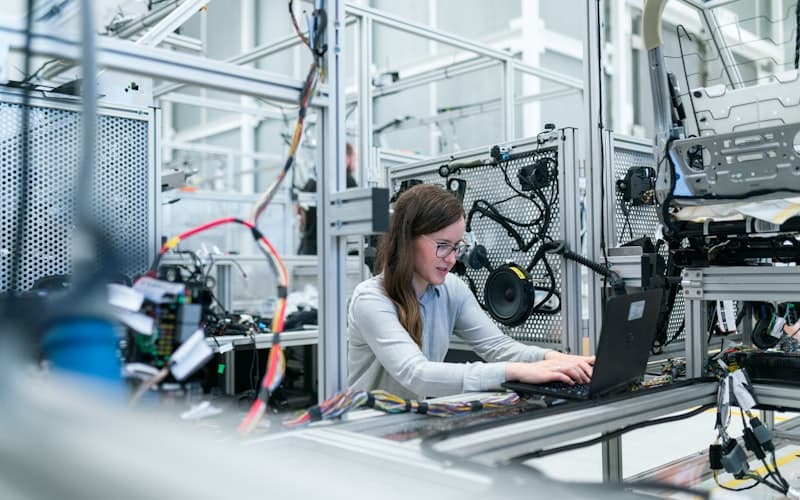
A digital twin is a synchronized virtual representation of a physical IoT device or system that mirrors its state, behavior, and context in real time through continuous telemetry ingestion and bidirectional data flow. Unlike a simple dashboard or monitoring tool, a digital twin maintains a rich data model encompassing the device's current sensor readings, configuration parameters, firmware version, operational history, environmental conditions, and a behavioral simulation model that can predict future states and failure modes. Cloud platforms like Azure Digital Twins (using DTDL, Digital Twins Definition Language), AWS IoT TwinMaker, and open-source options like Eclipse Ditto provide the infrastructure for creating and managing digital twins at scale. For embedded systems engineers, digital twins transform device management from reactive troubleshooting to proactive optimization: instead of waiting for a field failure, the digital twin runs physics-based or ML-based simulations to predict when a motor bearing will degrade, when a battery will deplete, or when firmware performance will degrade under specific load patterns.
How Does the Digital Twin Architecture Work?
The digital twin architecture consists of four layers. The physical layer includes IoT devices with sensors and actuators running embedded firmware that publishes telemetry (temperature, vibration, current, pressure) via MQTT, AMQP, or HTTPS. The connectivity layer handles device provisioning, authentication, and message routing through IoT hubs (Azure IoT Hub, AWS IoT Core). The twin layer maintains the virtual model: a structured representation of the device's properties (static attributes like serial number and firmware version), telemetry (dynamic sensor streams), commands (reboot, configure, update), and relationships (device-to-gateway, sensor-to-machine hierarchies). The analytics layer applies time-series databases (InfluxDB, Azure Data Explorer), ML models (anomaly detection, remaining useful life prediction), and simulation engines (physics-based models of mechanical wear, thermal behavior, or chemical degradation) to the twin's data.
What Does a Digital Twin Definition Look Like?
// Azure DTDL v2 - Digital Twin model for an industrial motor
{
  "@context": "dtmi:dtdl:context;2",
  "@id": "dtmi:embedcrest:IndustrialMotor;1",
  "@type": "Interface",
  "displayName": "Industrial Motor",
  "contents": [
    {
      "@type": ["Telemetry", "Temperature"],
      "name": "bearingTemperature",
      "schema": "double",
      "unit": "degreeCelsius"
    },
    {
      "@type": "Telemetry",
      "name": "vibrationRMS",
      "schema": "double",
      "description": "Vibration amplitude in mm/s RMS"
    },
    {
      "@type": "Property",
      "name": "firmwareVersion",
      "schema": "string",
      "writable": false
    },
    {
      "@type": "Property",
      "name": "maintenanceIntervalHours",
      "schema": "integer",
      "writable": true
    },
    {
      "@type": "Command",
      "name": "scheduleMaintenance",
      "request": {
        "name": "scheduledDate",
        "schema": "dateTime"
      }
    }
  ]
}
How Do Digital Twins Enable Predictive Maintenance?
Predictive maintenance through digital twins combines real-time telemetry with degradation models to estimate Remaining Useful Life (RUL). The digital twin ingests vibration data (accelerometer readings at 1-10 kHz), applies FFT analysis to extract frequency-domain features, and compares the current vibration signature against baseline patterns and known failure mode signatures. For bearing degradation, increasing energy in specific frequency bands (BPFO, Ball Pass Frequency Outer, BPFI, Ball Pass Frequency Inner) indicates developing faults weeks before failure. The twin maintains a cumulative damage index based on historical operating conditions, enabling RUL estimation with 85-95% accuracy when trained on sufficient failure data. This approach reduces unplanned downtime by 30-50% and extends component life by 20-30% through condition-based rather than time-based maintenance scheduling.
What Are the Embedded Firmware Requirements for Digital Twins?
Firmware considerations for digital twin-enabled devices:
- Telemetry reporting: Implement configurable sampling rates and adaptive reporting. Send high-frequency data (vibration at 1 kHz) to edge processing and aggregated summaries (1-minute averages) to the cloud twin. Use CBOR encoding to minimize bandwidth.
- State synchronization: Report device state changes (configuration updates, mode transitions, error conditions) as reported properties using the IoT hub's device twin mechanism. Implement desired-property handlers for remote configuration.
- Local buffering: Buffer telemetry in circular buffers during connectivity loss and batch-upload on reconnection. Use flash-based ring buffers for multi-day offline operation with LittleFS or custom wear-leveled storage.
- Edge pre-processing: Run lightweight anomaly detection on the MCU (threshold comparison, simple moving average, z-score) to flag events for immediate attention rather than sending all raw data to the cloud.
- Firmware versioning: Report firmware version, build hash, and feature flags to the twin. This enables fleet-wide firmware management and targeted OTA updates through twin queries.
How Do You Scale Digital Twins to Large Device Fleets?
Managing thousands to millions of digital twins requires hierarchical modeling and efficient query patterns. Model your fleet as a graph: individual sensor twins connect to machine twins, machine twins to production line twins, and line twins to factory twins. Azure Digital Twins supports graph queries using a SQL-like language to find all motors with bearing temperature above 80°C, or all devices running firmware older than version 2.3.0. AWS IoT TwinMaker integrates with Grafana for fleet visualization. For cost-effective scaling, tier your telemetry: high-value assets get per-second updates with full digital twin simulation, while low-value sensors get per-minute updates with simple threshold monitoring. Use device groups and tags to target OTA updates, configuration changes, and maintenance schedules to specific subsets of your fleet based on twin properties.
Key takeaway: Digital twins are synchronized virtual replicas of physical IoT devices that enable real-time monitoring, predictive simulation, and proactive maintenance. Cloud platforms (Azure Digital Twins with DTDL, AWS IoT TwinMaker) provide scalable twin infrastructure, while edge digital twins maintain local operation during connectivity outages. Firmware must support configurable telemetry, state synchronization, and local buffering.
How Did We Implement Digital Twins for a Fleet of Industrial Compressors?
At EmbedCrest, we deployed a digital twin solution for an HVAC manufacturer managing 2,400 commercial air compressors across 180 buildings. Each compressor was retrofitted with a sensor node (STM32L4 + ADXL355 vibration + MAX31865 temperature + ACS723 current) connected to a building-level gateway running our edge twin software on a Toradex Verdin i.MX8M Mini. The edge twin maintained a local state model of each compressor including operating hours, vibration signature baseline, thermal profile, and maintenance history, synchronized to Azure Digital Twins via Azure IoT Hub. We defined the twin model using DTDL (Digital Twins Definition Language) with interfaces for CompressorUnit, BearingAssembly, MotorAssembly, and CoolingSystem, connected through DTDL relationships. The edge twin ran a simplified physics model predicting bearing temperature based on ambient temperature, load factor, and running hours, alerting when the predicted temperature diverged from the measured temperature by more than 5°C (indicating cooling system degradation). Over 12 months, the twin-based predictive system detected 34 developing faults (28 confirmed, 6 false positives), reducing emergency service calls by 38% and enabling the HVAC company to transition from time-based maintenance (every 6 months) to condition-based maintenance (when the twin predicted remaining useful life below 30 days).
What Are Common Pitfalls When Building Digital Twin Systems?
The most expensive digital twin pitfall is over-engineering the twin model before validating the business value. Start with a minimal twin that mirrors device state (telemetry, configuration, firmware version) and provides threshold-based alerting. Add simulation models and predictive analytics only after validating that the basic twin delivers actionable insights. A twin model that is never used wastes development time and cloud compute costs. Second, telemetry oversampling wastes bandwidth and cloud storage. A vibration sensor streaming raw data at 25 kHz generates 4.6 GB/day. Instead, compute FFT features and anomaly scores on the edge device and send only 1-minute summaries (approximately 5 KB/day) to the cloud twin, reserving high-frequency raw data capture for triggered diagnostic events. Third, ignoring twin staleness leads to incorrect decisions. If a device goes offline, the twin's telemetry becomes stale. Implement staleness indicators that mark twin properties as "stale" after a configurable timeout and prevent automated actions based on stale data. Fourth, not planning for twin lifecycle management results in orphaned twins. When a device is decommissioned, its twin must be archived and deleted to prevent ghost devices inflating fleet metrics and incurring ongoing storage costs.
How Do Edge Digital Twins Complement Cloud Twins?
Edge digital twins provide critical capabilities that cloud-only twins cannot deliver. First, local decision-making during connectivity outages: if the cloud connection fails (common in industrial environments with unreliable internet), the edge twin continues monitoring and alerting based on its local model. When connectivity restores, it synchronizes accumulated data and decisions with the cloud twin. Second, latency-sensitive control loops: a cloud twin with 200 ms roundtrip latency cannot close a control loop faster than 5 Hz, insufficient for HVAC valve control or motor speed adjustment. An edge twin running on a local gateway achieves sub-millisecond response time. Third, data sovereignty compliance: in regions with strict data residency requirements (GDPR in EU, data localization laws in China, Russia), an edge twin processes sensitive data locally and sends only anonymized aggregates to the cloud. Implement edge twins using lightweight frameworks: Eclipse Ditto provides a Java-based edge twin runtime, or build custom twins using SQLite for local state storage and a simple state machine model in Python or C. Synchronize edge and cloud twins using the "desired/reported" property pattern from IoT Hub device twins, where the cloud sets desired state and the edge reports actual state, with conflict resolution favoring the most recent timestamp.